PreviewDiff: Multimodal Critic-Guided Search over Diffusion Latents
*Correspondence: vsub851@mit.edu
Abstract
Diffusion models produce striking images and videos, but they still struggle with compositional details such as object counts, attribute binding, spatial relations, and temporally grounded actions. Best-of-N sampling can spend more compute at test time, but it is open-loop: it only chooses among completed outputs and cannot repair a promising trajectory before it fails.
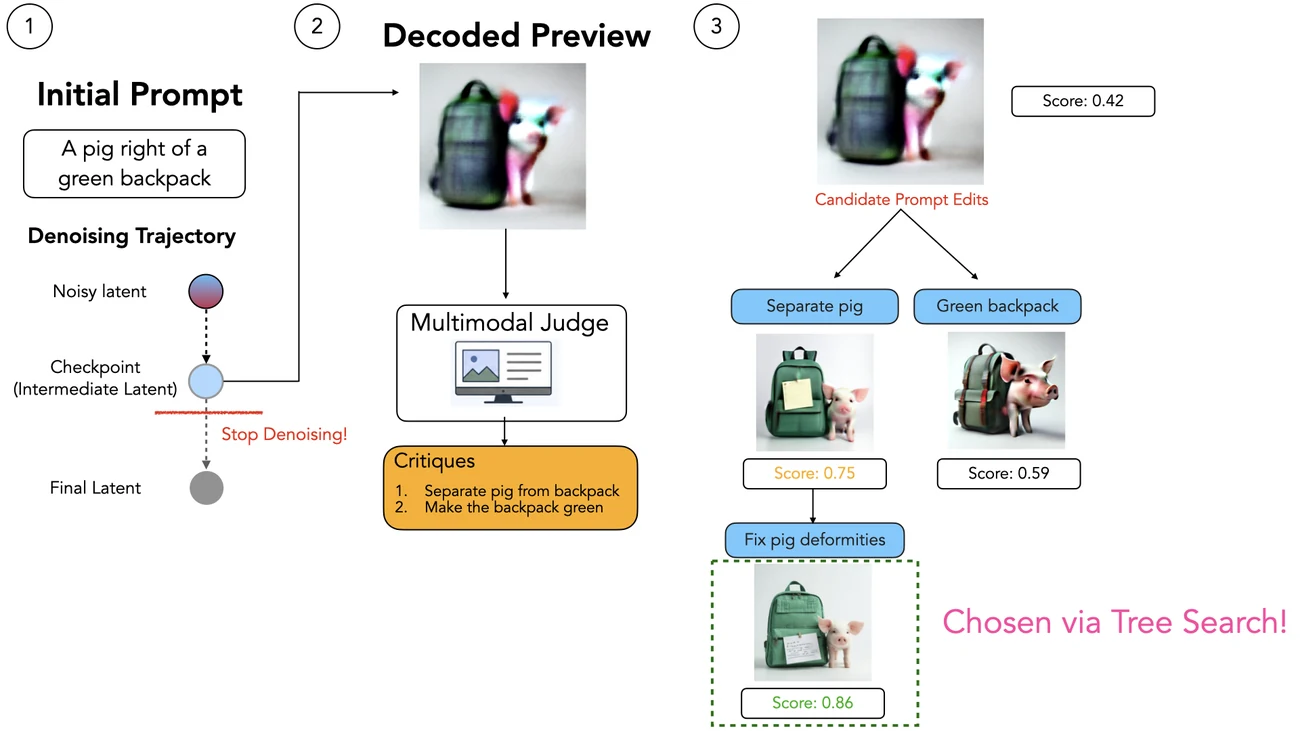
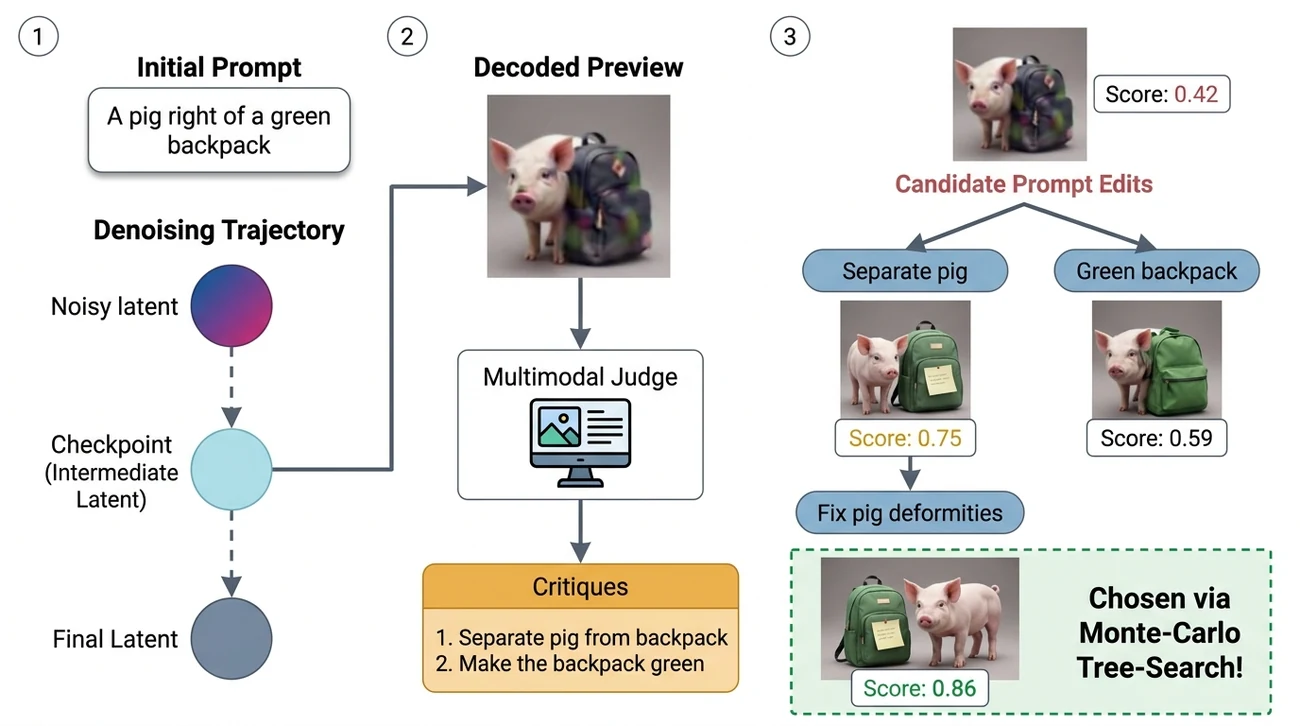
PreviewDiff is a training-free test-time search method that converts diffusion sampling into multimodal, critic-guided search over intermediate latents. At selected denoising checkpoints, it decodes a partial preview, asks a multimodal judge to score and critique it, and uses the resulting natural-language feedback to branch over semantic prompt edits and locally re-noised latent continuations. Across image and video benchmarks, PreviewDiff improves over budget-matched Best-of-N and scalar-search baselines.
What changes relative to Best-of-N?
Best-of-N selection
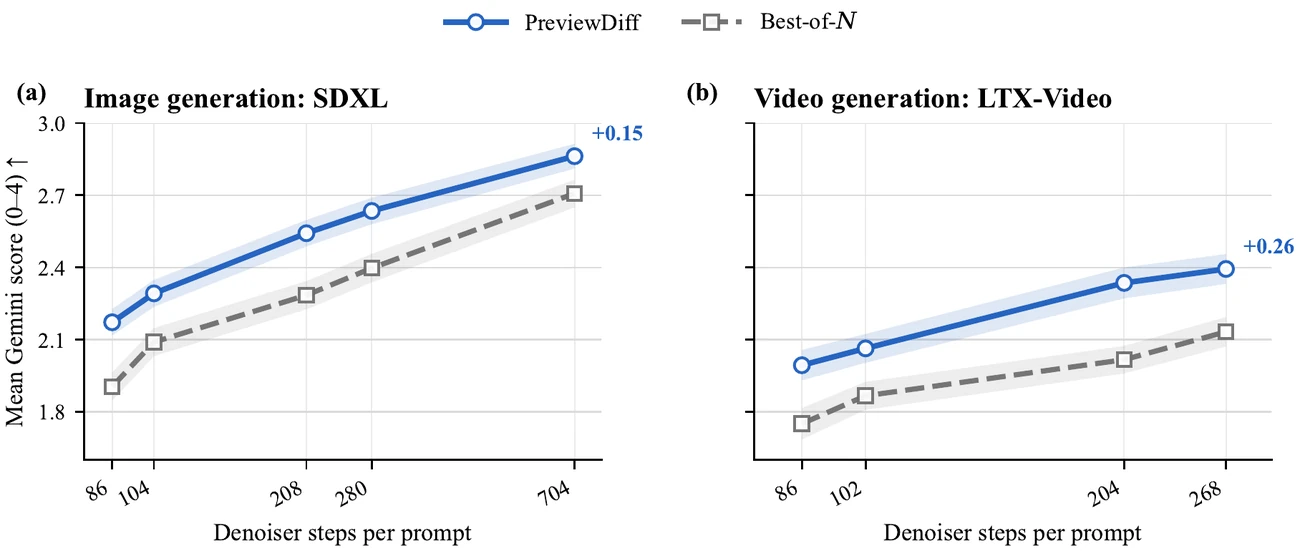
Samples many complete outputs, scores each final image or video, and returns the best one. This is simple and strong, but the verifier only acts after mistakes have already been baked into the final sample.
PreviewDiff search
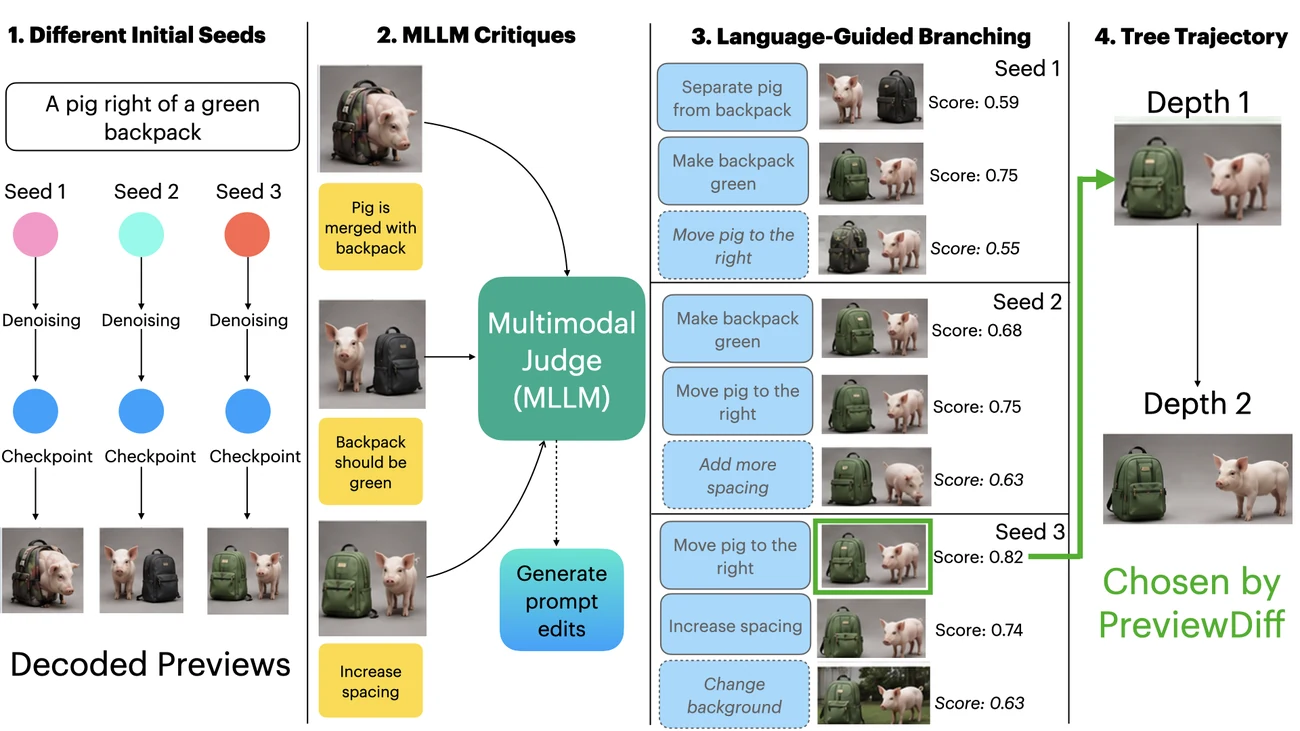
Uses the same kind of multimodal signal earlier. It previews partial denoising states, asks for a critique, branches over targeted semantic fixes plus local latent restarts, and prunes before spending full rollout compute.
- State: an intermediate clean-latent estimate, checkpoint time, positive/negative conditioning, and feedback history.
- Action: a compact positive fix note, optional avoid note, restart depth, and branch seed.
- Reward: a multimodal prompt-satisfaction score for the decoded preview.
- Tree policy: beam-pruned expansion with max backup over descendant values.
Results Summary
We find gains across image generation with SDXL, SD-3.5, and FLUX.2, and video generation with LTX-Video and Wan 2.2. The headline pattern is consistent: spending critic compute inside denoising beats spending it only on final-sample selection.
Fixed-budget results
Image generation
| Model | Method | GenEval2 Gemini P@4 | GenEval2 Qwen-3 Val | GenEval2 Qwen-3 P@4 | T2I-CoReBench Gemini P@4 | T2I-CompBench++ Gemini P@4 | T2I-CompBench++ BLIP VQA |
|---|---|---|---|---|---|---|---|
| SDXL | PreviewDiff | 2.292 | 1.9765 | 1.975 | 2.015 | 3.474 | 0.4844 |
| SDXL | Best-of-N | 2.090 | 1.5523 | 1.735 | 1.713 | 2.963 | 0.3976 |
| SDXL | EvoSearch | 2.103 | — | 1.6196 | 1.7543 | 3.013 | 0.4521 |
| SDXL | Particle-Sample | 1.902 | — | 1.7544 | 1.9154 | 3.003 | 0.4255 |
| SD-3.5 | PreviewDiff | 1.965 | 1.588 | 1.892 | 1.765 | 2.011 | 0.2566 |
| SD-3.5 | Best-of-N | 1.754 | 1.3854 | 1.713 | 1.545 | 1.913 | 0.2011 |
| FLUX.2 9B | PreviewDiff | 3.112 | 2.675 | 1.983 | 2.781 | 3.758 | 0.7851 |
| FLUX.2 9B | Best-of-N | 2.775 | 2.504 | 1.875 | 2.674 | 3.510 | 0.7256 |
Video generation
| Model | Method | T2V-CompBench Gemini P@4 | T2V-CompBench Qwen3-VL P@4 | LLaVA-Eval | NarrLV Gemini P@4 | NarrLV Qwen-2.5 Eval | V-Bench 2.0 Gemini P@4 |
|---|---|---|---|---|---|---|---|
| LTX-Video 9B | PreviewDiff | 3.021 | 1.987 | 0.4523 | 2.167 | 62.17 | 3.162 |
| LTX-Video 9B | Best-of-N | 2.716 | 1.411 | 0.3922 | 1.544 | 55.92 | 3.123 |
| LTX-Video 9B | EvoSearch | 2.814 | 1.901 | 0.3713 | 2.012 | 61.14 | 3.071 |
| LTX-Video 9B | Video-T1 | 2.861 | 1.954 | 0.4329 | 2.115 | 61.87 | 3.124 |
| Wan 2.2 A14B | PreviewDiff | 3.541 | 2.019 | 0.6311 | 3.411 | 71.22 | 3.554 |
| Wan 2.2 A14B | Best-of-N | 3.362 | 1.875 | 0.6011 | 2.874 | 68.16 | 3.292 |
| Wan 2.2 A14B | Video-T1 | 3.465 | 1.901 | 0.6266 | 3.229 | — | 3.509 |
Interactive PreviewDiff search tree
Prompt:
Move the slider to see the tree unfolding!
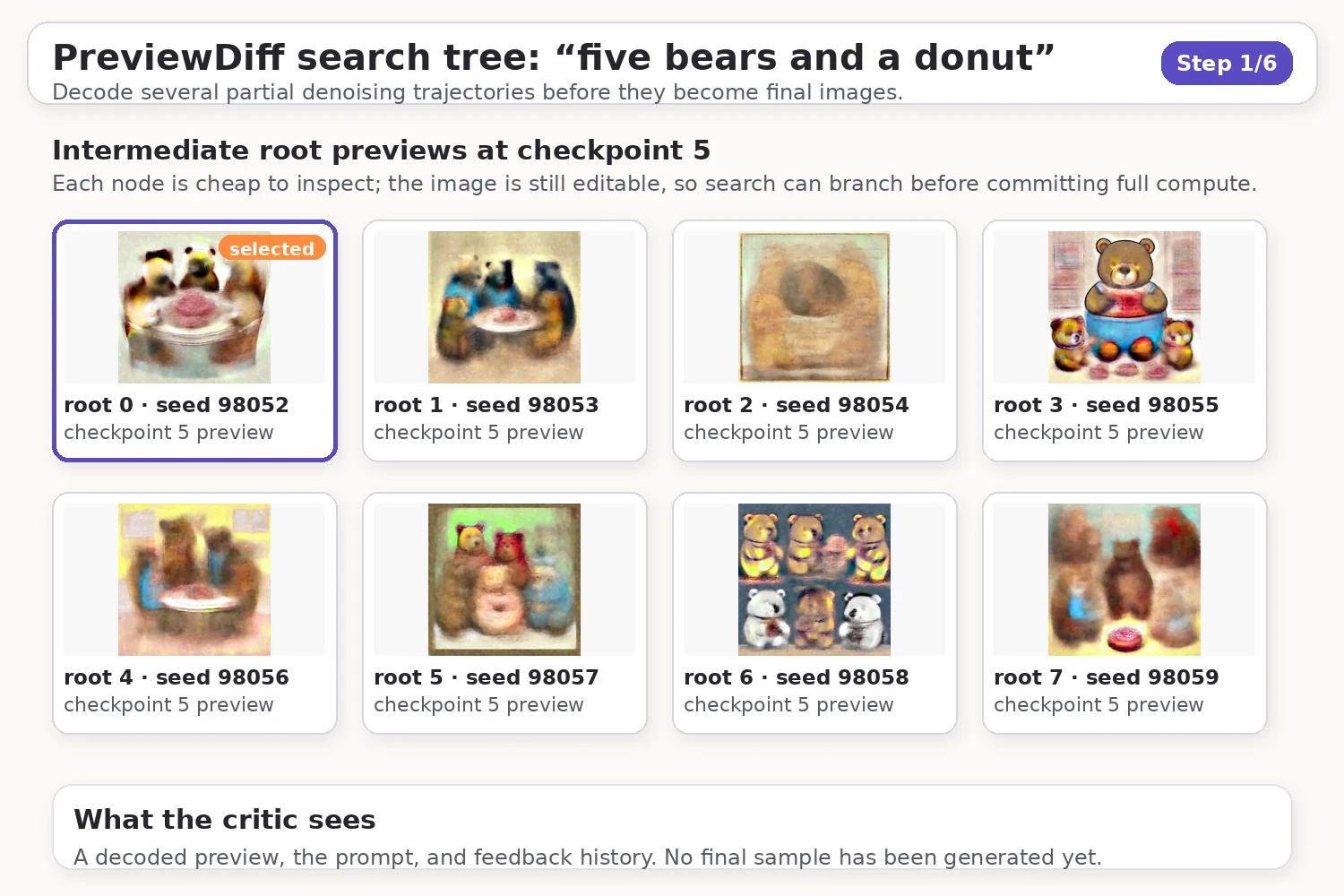
The controls will scrub through the tree-building process.
Explore a root-to-branch-to-final path
You can across root previews and click a child node. The diagram redraws the tree edges and highlights the chosen continuation.
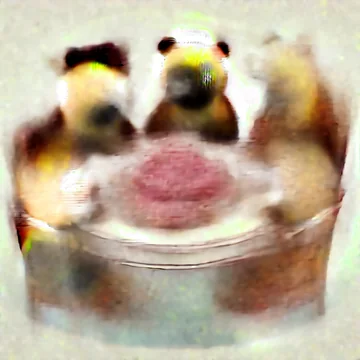 root 0
seed 98052 · cp5
root 0
seed 98052 · cp5
Select a root to update its child branches.

Selected child branch.
PreviewDiff search walkthrough
This paper figure follows one search from intermediate root previews through critic feedback and branch scoring to the selected final generation.
PreviewDiff vs Best-of-N qualitative examples
Use the slider to compare PreviewDiff with one Best-of-N sample.
Example
1 / 15

PreviewDiff vs Best-of-N video examples
01 · Warm streetlights on snow
1 / 10In a snowy nighttime setting, the streetlights cast a warm, orange glow over the quiet street.
The two videos restart together when the example changes. Use “Play all” or “Restart” to compare motion from the same point in time.
What matters in the search?
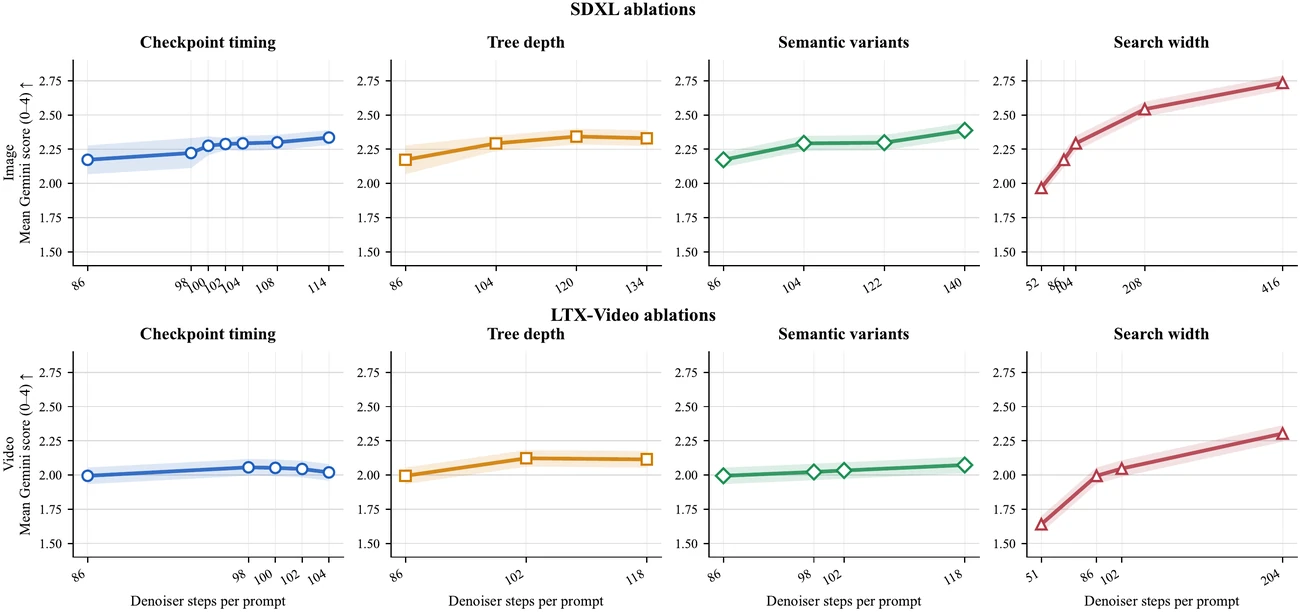
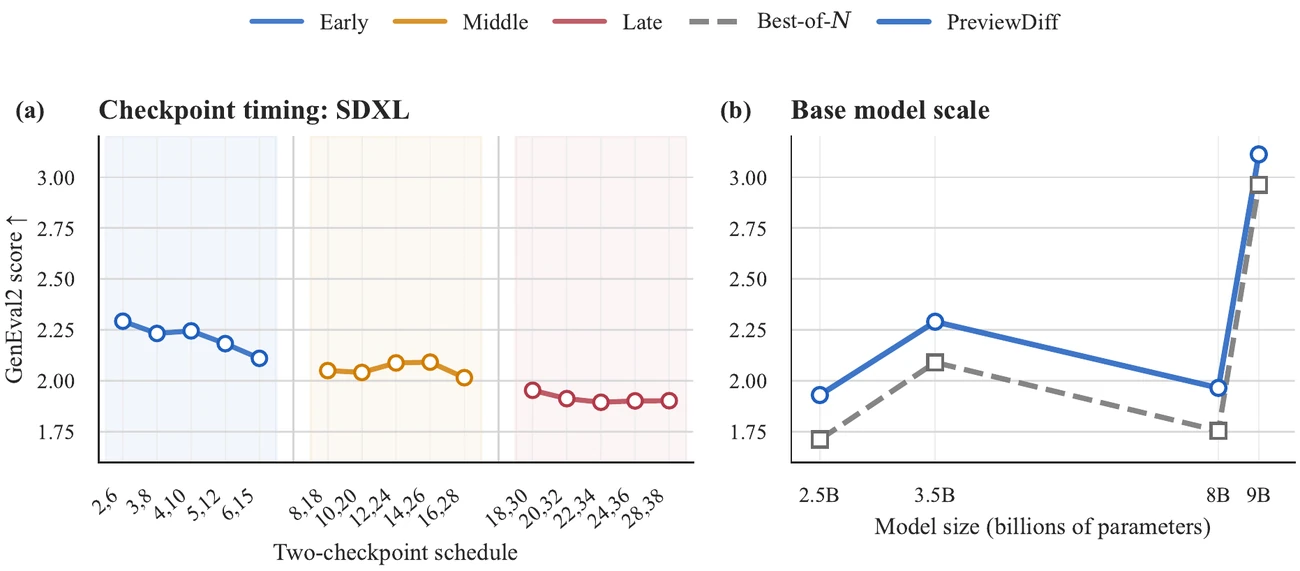
The paper’s ablations show that search width produces the largest gains, while depth and semantic variants provide complementary improvements. Earlier checkpoint intervention is useful because it leaves enough denoising time for a correction to affect the sample.
Human evaluation
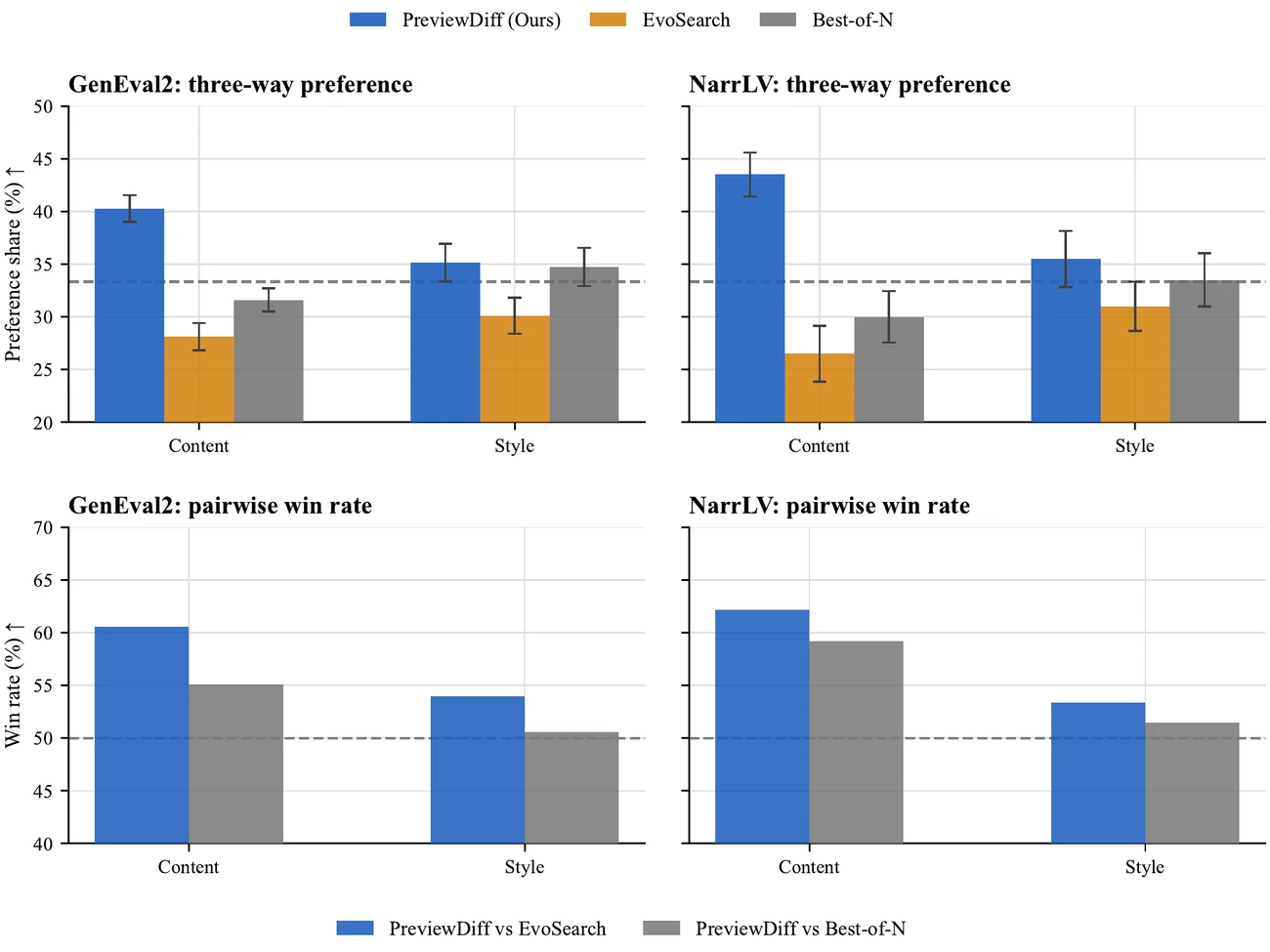
Human raters compare PreviewDiff, Best-of-N, and EvoSearch on content and style. The strongest gains are on content, which matches the method’s focus on prompt adherence: objects, attributes, counts, relations, and actions.